Tuesday, September 30, 2008

Root-based Iron Tonic


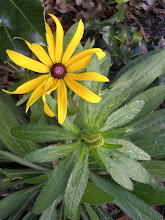
Yellow Dock (Rumex crispus) grows profusely in my yard. It is a prairie plant and is also called curly dock due to its curled leaves. You can see rust spots on the leaves, indicating the plant pulls iron from the soil and thus is a good iron remedy.


Last week I made up some very good Iron Tonic. This recipe is from herbalist Aviva Romm and it's great for people who are anemic or maybe need an iron supplement for other reasons. I have given this to two friends who are chronically anemic and both have said the Iron Tonic has helped their energy levels.

Here's the recipe:

1/2 ounce each dried dandelion root and dried yellow dock root
1/2 cup blackstrap molasses
1/8 cup brandy (optional; to preserve)

First harvest the roots and chop them into small pieces (about 1/4" thick rounds). Dry the pieces on a cookie sheet at the lowest oven temp. for 15-20 minutes. Alternatively, you can purchase them already dried from a good source such as Mountain Rose Herbs.
Put the roots in a quart jar and cover with boiling water. Let sit 4-8 hours or so. Strain into a pot and simmer off until you're left with 1 cup of liquid infusion. Add to this the blackstrap molasses while still heating then remove from heat, and add brandy if using. Preserve this in the refrigerator or very cool place. It should keep 3-4 months especially with brandy--it will mold when it goes bad. One recipe yields 1 and 1/2 to two cups tonic. The dose is 1-2 tablespoons daily. Take it with 250 mg Vitamin C for best absorption.

Friday, September 19, 2008

Calendula

Blurry calendula flowers in my garden; they self-sow prolifically


This is a busy time of year for an herbalist. There are so many herbs just ready to be "put up" into tinctures and oils. It's the time to gather roots, especially. In the next couple of days I hope to harvest some of the yellow dock that has "taken root", literally, all over my yard. I will make an iron tonic with the dock roots and do a post on that when I get it done.


I'm also trying to get the last of the flowers and herb leaves preserved in some way before frost. The chamomile long ago stopped blooming and from one plant I didn't get much to dry for winter teas, so I've ordered 8 ounces more from Mountain Rose Herbs, the favorite herbal company of herbalists I know. I'm drying sage, thinking of that turkey stuffing, and lavender, parsley, thyme, and so much more.
Calendula flowers wilting for 24 hours before I steep them in olive oil


The one thing I've got steeping yet is Calendula flowers in olive oil to make a nice oil to use as a rub. Calendula is great for the lymphatic system. It's a very sunny-looking plant and has a particular affinity for "places where the sun don't shine". This includes the armpit area, full of lymph nodes, and the underwear lines in the pelvic area. You know you have lymphatic stagnation if you feel tenderness in those areas. I get tenderness in my armpits and around my breasts so this oil is for me to use when that happens.
My calendula oil steeping 6 weeks, and putting out "sun rays" to remind us of its sunny disposition (or is that just bad photography?)


The Victorians called Calendula "liquid sunshine" and put the fresh or dried flowers in soups to add nutrients and work as an anti-depressant. It's particularly suited for Seasonal Affective Disorder, known as S.A.D. and occuring in winter when the days are dark. The nutrients in Calendula are good for the immune system and because it helps the flow of lymph that helps to maintain health in general.


You can also make or purchase a Calendula wash which is basically a strong tea. This is particularly good for "cat scratch" type of cuts that are puffy and oozing signifying, again, poor lymphatic draining. Calendula wash is also generally helpful for skin irritations, rashes, bites, dryness, and it helps cool and calm a sunburn.


Monday, September 8, 2008

Lemon Balm Instead of Valium?

Melissa officinalis, aka Lemon Balm, in my garden

I thought that title might get some attention! Just the other day a friend and--now former--co-worker and I were joking about needing some valium to get us through the stresses of life. The two of us, Buyers for the Health and Body Care department at a natural foods co-op, got a laugh out of the irony of us wanting some valium. It's really no joke, though.

Valium (good history at this page), immortalized by the Rolling Stones as Mother's Little Helper, was introduced by Roche Labs in 1963 as the first "lifestyle drug". The company was later accused of not warning the public or doctors of the addictiveness of Valium. Of course, more money can be made if you get the public addicted first! In its first ten years, Valium had been prescribed to 59.3 million patients, bringing in a new era of blockbuster medicines and "turning to a little pill" for help in getting through your day.

Herbs don't work this way. They are not "your little pill" and they never should be thought of as a quick fix or crutch. That said, there are many herbs and flower essences that can help with anxiety and stress. An herb can be taken in tea or tincture form as a help to relax, but you won't get addicted and you will be doing your whole body a favor if you find the right herb for you as it will work systemically. That is, throughout your whole system--body, mind, spirit--to bring balance back to your life.

Lemon Balm (Melissa officinalis) is one of my favorite herbs for this purpose. (There are others of note: agrimony and prickly lettuce were my constitutional remedies when I first started taking herbs, and favorites of my herbalist Lise Wolff; blue vervain is another; most of the mints tend to be cooling and calming, as well as members of the Rose family like peach leaf and wild cherry; chaomomile; lavender; and I'm sure many more not on the top of my head at the moment.)

Lemon balm is a member of the mint family. It makes a delicious tea both hot or iced, and a tincture of the fresh herb is handy and tasty as well. Lemon Balm works best as a fresh herb--you can dry it for tea-making in winter but its medicinal value will be lessened. It's better to tincture the fresh herb for medicine, and use the dried tea as little more than a tasty beverage.

Now might be just the time to make that fresh herb tincture, before the frost. Earlier in the summer would be better, though. If your lemon balm has gone to flower the most potent remedy cannot be made, though I'd make it anyway if you want some for this year. Include the flowers if they're there. In my somewhat shady/part sun spot, my lemon balm has not flowered so I can make a tincture of just the leaves and a bit of stem. That is best.

I once made myself a pot of lemon balm tea and proceeded to drink three cups of it. Beware! You can drink too much of this sedative herb at once. However, this was just what I needed that day. I'm a bit of an insomniac, especially in summer, and on that summer afternoon after my tea time, I lay down on my hard porch floor with just a little pillow under my head and fell fast asleep for three hours. After not sleeping much for days, that sleep was restorative.

Lemon balm is known for its cooling properties, valued in hot climates. It has a sour, lemon flavor which is rare in the mint family, and very thirst-refreshing. It helps in fevers by helping to open the pores so the feverish person can sweat out the heat. I have also given lemon balm tincture to a client for hot flashes during menopause. She had a background of some tension along with depression, and a red pointed tongue indicating heat throughout the body (in Chinese medicine) which is a specific for lemon balm.

It can help to calm a spastic cough. It eases heart palpitations and general anxiety. Being a mint, it is also a carminitive, which means it helps with digestion. It will ease gas and nausea and especially helps for nervous indigestion. For this the hot tea after a meal is best.

My teacher Matt Wood says at his website page on lemon balm:


The dosage can be as small as 1-3 drops (when it's a specific and for that you probably need to see an herbalist) or as large as 10-30 drops. I generally recommend 5-10 drops twice a day, morning and evening for a chronic condition, more often in an acute situation such as when trying to calm heart palpitations or cooling a fever. Too much of any herb, however, and the remedy will no longer work. Don't overdo. It is considered a very safe herb.

Friday, August 22, 2008

September 13 Minnesota Herb Fest

I had said in my last post that I was next going to write about Echinacea. Well, for two reasons I'm going to postpone that one. Number one, because it's not quite time to harvest roots yet. For that we'll wait till the flowers die back, later in the fall. You want to make a root medicine when the energy of the plant is strongest in the root. This is in the fall when its energy is going to the root and not the upper body of the plant. Then the root's "sugars" and therefore, its medicine, are strongest.

The second reason I'm going to wait is because of an herbal conference/festival I'm attending here in Minnesota in September. I think I will have an even better understanding of Echinacea after I take the following workshop class:


The Immune System: Not What you Think it is...with Lise
Wolff.
If you think "fighting off" a cold is the role of the immune system, think again! ( The immune system reflects our response to the world, both physically and emotionally). This provocative class will shake up your understanding of how the immune system functions and what foods, herbs and flower essences make it healthy. Away with Echinacea!

Lise Wolff was my herb teacher for the full year of 2005. From her, I already have a different understanding of Echinacea than the current popular notion of it as an "immune booster" or "virus fighter". But I think waiting for this class and brushing up on my understanding of the plant and its uses, as well as the immune system's role in our bodies, will help me present Echinacea in a more useful light.

In the meantime, if you want to nourish your body and help it to "fight off" (ha ha, not a kosher way to put it in Lise's book--I've got to figure out how to get my language right, obviously) viruses and flus, see my post on Elderberry.

And if you live near Minnesota and want to spend a day on a beautiful farm in Cannon Falls (SE Minn.) taking classes from a variety of top-notch herbalists, do come to the 3rd Annual Holistic Health and Herbal Education Festival. Click on the link for more information. The HerbFest is September 13, so hurry and register soon!

Wednesday, August 20, 2008

Testing...Testing...Is This Microphone Working?

That's how I'm feeling about this blog at the moment. It's apparent from you, my dear readers, leaving me comments that you are eagerly awaiting more posts by me on herbal remedies. I so, so appreciate your comments and I feel terrible being slow about this and letting you down! I fully intend to do more posts on these great plants, but let me explain a bit about my current slowness.

One, writing up each herb is a lot like writing a paper for school. It's a lot of work, with some research and a lot of thought on my part on how to best teach you about an herb. A lot of it I'm writing from my own head and personal experience, but I have to be careful on what I write. I take it so seriously because I take herbal medicine seriously. Herbs are potent medicine and if I screw up I run the risk of endangering someone's health. This is probably the main reason why I (and other herbal students I know) am/are slow at starting an herbal practice.

You see, there is very little in the way of herbal "degrees" or certification out there, and even if there is something like that, a student of herbal medicine can never know "enough". There's always room for study, for learning and experimenting and spending more time with the plants to know them better. I am trying to give some very basic information here, and to keep it fairly seasonal at least for now, but even into that basic information there enters a lot of thought and study.

Okay, for another reason, I've been working at my job at a natural foods co-op a lot this last part of the summer, and it's wearing me out. However, in two weeks I will be done with that job. Then it's time to take my herbalist practice even more seriuosly (along with homeschooling my kids). Expect more from me at that time!

In the meantime, I hope to write a short blurb about Echinacea in the next couple of days. Stay tuned!

Tuesday, August 5, 2008

Elder: Sambucus canadensis

This is a post I wrote for my other blog, The Zahn Zone, last winter. It is almost time to harvest Elderberries in Minnesota (in September) and it may be even closer for you, so I thought I'd post it on this site for your "reading pleasure".

Reprinted from February 2, 2008:


George has been sick with a terrible cold this week. Due to having no voice, he actually missed three days of school, a record for him. Last night as he lay in bed, keeping us both awake with his coughing, I thought of my elderberry cordial. Fortunately, he was thinking the same thing as he went downstairs at about 12:30 a.m. to drink some. It definitely calmed his cough and we both slept better after that. (Okay, it also helped that he slept on the couch for the next four hours…he did say his cough calmed down, though.)

Elder (Sambucus canadensis here in N. America; S. nigra in Europe) is my favorite herbal remedy, and one of my favorite plants ever. The Elder tree or bush grows wild all over Minnesota, on our farmlands near damp places, along roadsides and on the edges of woods. I’ve also seen it near my in-laws’ place on the Ware River in the Tidewater region of Virginia--a damp, low place very different from Minnesota but still providing the conditions just right for wild Elder.

You can buy Elder bushes at the nursery, too, and they’ll grow well in most yards. I have planted two (for pollination you need at least two) in the corner of my front yard, on our city lot, and they’re growing beautifully. My herb teacher, Matthew Wood, in his Book of Herbal Wisdom: Using Plants as Medicines, writes that “planting an elder in the corner of an herb garden is considered to be beneficial to the medicinal plants growing there because the Elder serves as a sort of tutelary spirit to the herbs”. So of course, I decided to plant a couple near my garden!
I have two favorite things I love about Elder: one, it is steeped in legend and lore, something that thrills me in general and two, it is hands-down the best remedy for coughs, colds, flus, fevers, digestive upsets, colic, and more.

Matt Wood writes: “In northern Europe the Elder was associated with a powerful female being called the Elder Mother…It was considered a potentially fatal mistake to pick the plant without making an offering. The most common practice was to ask for some of the plant in exchange for notifying the Elder Mother that one‘s body would eventually be returned to the earth. In England, Elder wood crosses were placed on the new grave in hopes that it would bring the departed person peace.” (ibid.)

Elder was considered a door to the Underworld. It is featured in many fairy tales. “When Christianity appeared, Elder came to be associated with Jesus…After his crucifixion, Jesus went down into the Underworld to free the souls of the dead…The Elder, as tree-doorway to that realm was a natural addition when the story of Jesus reached Europe.” (ibid.)

Elder branches are tubular and tubular plants suggest open communication, even with other worlds. I always think of Elder as a “tubular remedy”, meaning it clears out the tubes of the body whether respiratory, digestive, circulatory, etc.

One of my Elder bushes in flower, in mid-July.
Everything is a bit late this year (2008) so their
flowering and berrying may be later than usual.


Elder flower tea is my first line of defense when we have a fever. The flowers made into a tea are good for sweating out a fever, and when I’ve drunk it I’ve experienced instant relief and a shortened duration to my fever. I can actually feel my skin “sweating” a bit, and tingling. I’ve had similar luck giving it to my kids. One teaspoon of dried flowers to one cup of boiling water, covered and steeped ten minutes, strained then sweetened with honey, is really tasty too. If my daughter will drink it, anyone can! You can buy dried flowers at any co-op or herb shop, which is what I do because I prefer to let my elder flowers turn into berries on my still-small plants.
Here is my Elder today, August 4. The berries are still green. In a month or so they'll be blackish-purple and drooping luxuriously from their branches. The flowers and berries form an "umbrel-type" flower, like an umbrella. Note the reddish-purple stems. When the berries are ripe, the umbrel part will just "pop off" the larger stem/branch at your touch.

The berries are super-nutritious. They’re not very sweet when fresh, but you can dry them for a sweeter flavor and put them in your cereal all winter. You can also make jam, chutney or cordial with them. I make an herbal tincture of them steeped with brandy or vodka for six weeks, then give my family members a dropper-full at the first sign of any illness. Some people take the a dropper-full of tincture every day during the winter. You can certainly buy the tincture at a health food store, too, and use that. I recommend everyone keep some Elderberry tincture in their home; it is more useful and better than the popular Echinacea, as I was taught by my herb teachers, and in my own experience as an herbalist. When the bird flu hits, this is one remedy you’ll want to use!

My husband in particular loves the Elderberry Cordial I made a couple of years ago. He’ll drink a shot glass full at night whenever he has a cold or flu. Here is the recipe:

4 c. fresh elderberries
2 c. sugar
1 t. lemon zest
2 T. fresh squeezed lemon juice
1 c. water
3 c. 100 proof vodka (I think I used 80 proof)

Crush elderberries and sugar together in a bowl. Let stand for about an hour. Add lemon zest and lemon juice. Transfer to clean 2-quart container and add water and vodka. Cover and let stand in a cool dark place for one month, shaking occasionally.

Use a fine-mesh strainer to strain out the solids. Discard into your compost (and please do compost any herbal “waste”; find a way to return it to the earth and the plant will be happier to help you out). Transfer liqueur to a clean container. Cover and age for at least one month before serving. Yields about 1½ quarts.

This recipe came from my teacher, Lise Wolff, RH AHG, who got it from Cordials From Your Kitchen by P. Vargas and R. Gulling.

There are many other recipes out there using Elderberry. You can make an Elderberry Syrup which would be better for your children. Herbalists like Rosemary Gladstar have wonderful recipes for this.

I am so grateful to the Elder Mother plant for her contributions to my family’s health. If you’re interested in natural, herbal remedies, I can’t recommend this plant highly enough. Find some in the wild if you’re lucky, or plant your own as I have. And always give thanks for nature’s gifts!

Tuesday, July 22, 2008

Let Me Introduce You To My Friend Plantain

Plantain (Plantago major) growing robustly on my garden path

Today I have the perfect moment to write about a common weed that is an uncommonly great herbal remedy: plantain.

Earlier this morning I was moving a compost pile from the spot where our chicken coop is going to go when all of a sudden a swarm of honey bees flew at me. Fortunately, I was stung only two or three times, and fortunately I'm not allergic, but the whole incident had me almost hyperventilating and the bee stings hurt like he**!

And what remedy came to my rescue? Why, the "lowly" plantain of course! Plantain is THE remedy for bee stings, bug and snake bites. Oh, there are others but plantain is so easy and so readily available everywhere. Its nickname is "white man's walk" because it grows where people walk, or on old trails (horse, deer, or man's). And also because the white man brought plantain over from Europe, along with dandelions and many other of our noxious weeds/invaluable herbal remedies and food. If plantain is growing in your yard as it is ours, it's a sign of compacted earth and it's often advised to aerate your lawn to get rid of it. You might find plantain growing along your sidewalk, as it is along mine in the photo below (next to thyme on the patio).
My favorite way to use plantain in the summer during prime bee sting season is to just take a leaf and make a lot of bite marks in it to get the juices going. Then hold the leaf on the sting like a band-aid and it will provide relief in a short time. I have impressed so many bee-stung kids with my "green medicine" this way! I also have plantain salve which works great if you put a band-aid or compress on top of it--you need something be it leaf, band-aid or piece of cloth, to which the stinger can attach itself. Today in my moment of panic I first grabbed some leaves and started biting, then ran into the house for salve, then had George get some band-aids, then I grabbed some compresses. The combination of it all did manage to calm me down and provide relief. I think in the end the whole leaves with bite marks in them and held on by a compress provided the best relief, but plantain salve is still a great ally for times when you can't find plantain growing.

Other uses for plantain leaves or salve: bites of all kinds, puncture wounds, slivers, dirty cuts and scrapes, or any abrasions. Plantain will draw out pus, dirt, shards of glass, slivers, etc. Then it will promote healing cell growth (class notes, Herbalist Lise Wolff lecture). You can also pack plantain leaves into your mouth for a toothache and it may draw out infectious materials and relieve the pain. It relieves canker sores as well. Plantain leaves or salve could be of great use to you during a dental emergency such as a root canal situation, but obviously see your dentist too!

I gave a client both plantain and white oak bark (quercus alba) tinctures for a series of dental problems she had. She still needed lots of oral surgery, but its possible the herbal remedies helped speed the healing. She didn't need as much antibiotics as usual.

Plantain tincture is an excellent general sore throat remedy. If you eat plantain when it's a little bit too big, you get some of its threads stuck in your throat so this can remind you that plantain tincture can heal sore throats when it feels like there's something stuck in there. (This is based on one herbal medicine/homeopathic principle--that herbs cause what they cure and cure what they cause--called the Law of Similars). For sore throats of any kind, take one drop under the tongue twice a day.

According to my teacher Lise Wolff, RH (AHG), Plantain is anti-bacterial, anti-inflammatory, analgesic and astringent. The tincture may also work for gastritis and cystitis where it cools inflammation. It may be indicated in cases where the kidneys and liver have been stressed by use of pharmaceutical drugs or heavy metal toxicity. I have less experience with these uses but if given the chance I would try plantain in these types of cases since its such a readily available local herb.

One last "signature" for Plantain is of the sole of the foot. Plantain/Plantago:Plantar have the same latin root word and plantar is the word for foot. Plantain can be used for relief of plantar fascitis and in this case you can use it in any form, tincture, leaf or salve.

One can look for these reminders for the uses of herbal remedies in the latin terms, the nicknames and even sometimes in the way a plant looks. In the case of plantain, the leaves have strings that one can see when you pull the leaf from its stem. Those strings remind me of plantain's ability to draw out toxins and bind up injuries--like a needle and thread.

The seeds of plantain are psyllium seed, the same stuff you can buy for a fiber supplement. Psyllium seeds are not only a good source of fiber for bulk in your diet, but they can pull parasites out of the intestines and pass them through the bowels. All parts of plantain are edible, the leaves and the seed pods. You'll want to eat the plantain leaves very early in the season when they are small and tender. They like all greens are very high in vitamins and minerals.